
A hydraulic jump is a phenomenon in open channel flow where high-velocity (supercritical) water transitions abruptly into slower-moving (subcritical) flow. This results in a sudden rise in water surface elevation and forms turbulent waves, dissipating energy.
Understanding Open Channel Flow Regimes
In open channel hydraulics, flow conditions are typically categorized based on the Froude number (Fr). The Froude number is a dimensionless number that represents the ratio of inertial forces to gravitational forces in a fluid flow.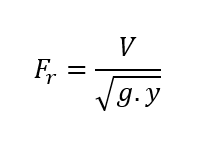
Where:
V = Flow velocity
g = Acceleration due to gravity
y = Hydraulic depth
The flow conditions are classified as:
- Supercritical (>1): Fast and shallow
- Subcritical (>1): Slow and deep
- Critical (=1): Transition point between flow states
Types of Hydraulic Jumps
Based on the Froude number, hydraulic jumps are classified into the following types:
- Undular jump
- Weak jump
- Oscillating jump
- Steady jump
- Strong jump
| Froude Number | Jump Type | Description |
|---|---|---|
| 0-1 | No jump | NA |
| 1-1.17 | Undular | Gentle surface waves, minimal energy loss |
| 1.7-2.5 | Weak | Slight turbulence, minor energy loss |
| 2.5-4.5 | Oscillating | Unstable location, irregular motion |
| 4.5-9 | Steady | Stable jump, efficient energy dissipation |
| >9 | Strong | Highly turbulent, violent flow transition |
Undular Hydraulic Jump
Undular hydraulic jumps are characterized by the presence of smooth, oscillatory waves propagating downstream. The rise in water surface elevation during undular jumps occurs gradually.
Weak Hydraulic Jump
Weak hydraulic jumps are characterized by a lesser increase in water surface elevation and reduced turbulence in the flow downstream. It represents a milder form of the steady hydraulic jump.
Oscillating Hydraulic Jump
Oscillating hydraulic jumps are characterized by regular fluctuations in water surface elevation and flow characteristics, alternating between supercritical and subcritical flows in a cyclic manner.
Steady Hydraulic Jump
Steady hydraulic jumps are characterized by an abrupt increase in water surface elevation, turbulent waves, and substantial energy dissipation. It is a prevalent and well-recognized type of hydraulic jump.
Strong Hydraulic Jump
Strong hydraulic jumps are characterized by a higher increase in the water surface elevation and a more turbulent flow downstream compared to steady hydraulic jumps.
Engineering Implications of Hydraulic Jump
While a hydraulic jump is a flow phenomenon, its effects can be utilized in civil engineering design and stormwater management:
- Energy Dissipation:
Hydraulic jumps are mainly used to dissipate excess energy from high-velocity flows. They reduce flow velocity, prevent soil erosion, and protect hydraulic structures, such as spillways, weirs, and energy dissipators.
- Flood Management:
Hydraulic jumps play a crucial role in regulating the flow of water in rivers, channels, and flood control structures. By dissipating energy and reducing flow velocities, they help prevent excessive erosion and minimize the risk of flooding downstream.
- Fish Passage Design:
Hydraulic jumps are considered when designing fish passages and fishways, allowing fish to navigate barriers such as dams and river obstructions. The energy dissipation caused by them provides favorable flow conditions, enabling fish to pass safely without experiencing major stress or injury.
Hydraulic Jump in GeoSTORM
In GeoSTORM, the user can visualize hydraulic jumps that occur within a pipe in stormwater drainage systems. If a hydraulic jump occurs, the user can view it in the software using the Profile Plot command.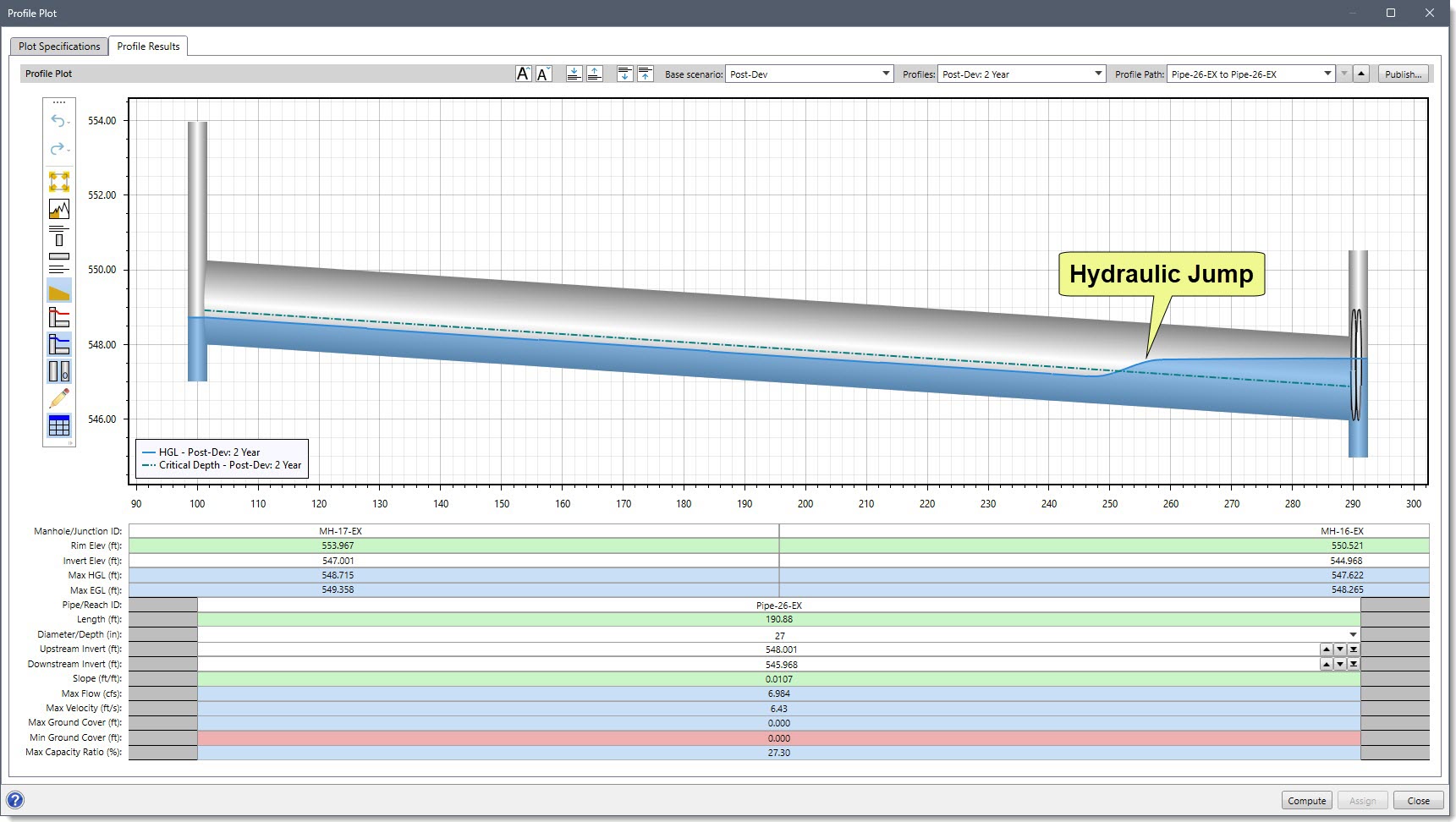
Refer to this article in our knowledge base to learn more about the Profile Plot command.