
Infiltration methods are used to simulate how rainfall or surface runoff is absorbed into the ground through pervious (absorbent) surfaces like soil within a subbasin. This process is important for estimating how much water infiltrates the soil compared to the amount that becomes surface runoff, and for designing drainage systems, and predicting floods.
In GeoSTORM, the following EPA SWMM infiltration methods are available:
- Green Ampt
- Horton
- Modified Green Ampt
- Modified Horton
- SCS Curve Number
This article describes each EPA SWMM infiltration method available in GeoSTORM.
Selecting an Infiltration Method
Follow the steps below to select an infiltration method:
- From the Input ribbon menu, click the Scenario Manager dropdown menu, and select the Scenario Manager command.
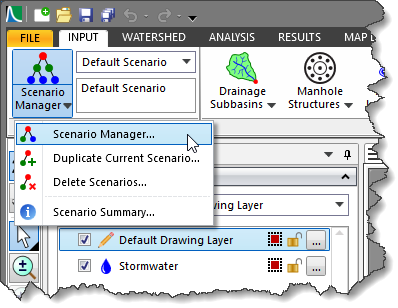
- The Scenario Manager dialog box will be displayed, as shown below.

- From the EPA SWMM infiltration method dropdown combo box, select the infiltration method.
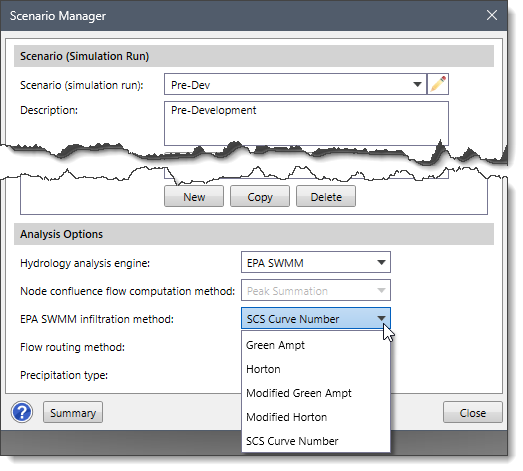
Note: The EPA SWMM infiltration method dropdown combo box is only enabled when EPA SWMM is selected as the Hydrology analysis engine. Otherwise, this dropdown combo box is disabled (i.e., grayed out).
Green Ampt Method
This infiltration method assumes a sharp wetting front exists in the soil column, which separates soil with some initial moisture content from saturated soil above.
In GeoSTORM, the Green Ampt infiltration method utilizes the following parameters:
- Soil capillary suction head
- Soil hydraulic conductivity
- Soil initial deficit
The following table summarizes the main pros and cons of the Green Ampt infiltration method:
Pros| Cons
| |
|---|---|
| This method’s parameters are related to soil properties (e.g., porosity and hydraulic conductivity) that can be measured in the laboratory. | This method assumes an overland flow approach, making it less applicable in forested areas where subsurface flow typically controls direct runoff. |
Horton Method
This infiltration method is based on empirical observations, which show that the infiltration rate decreases exponentially from an initial maximum rate to a minimum rate during a long rainfall event.
In GeoSTORM, the Horton infiltration method utilizes the following parameters:
- Maximum infiltration rate
- Minimum infiltration rate
- Horton decay constant
- Maximum infiltration volume
- Saturated soil drying time
The following table summarizes the main pros and cons of the Horton infiltration method:
Pros| Cons
| |
|---|---|
| This method is well-suited for urban and agricultural areas where infiltration capacity is relatively small due to cultural activities. | This method is not recommended for forested soils, as overland flow is rare in such environments. |
Modified Green Ampt Method
This infiltration method modifies the original Green Ampt method by preserving the moisture deficit in the soil’s top surface layer during initial periods of low rainfall. This change results in more realistic infiltration estimates for storms with long initial periods where rainfall intensity is below the soil’s saturated hydraulic conductivity.
In GeoSTORM, the Modified Green Ampt infiltration method utilizes the following parameters:
- Soil capillary suction head
- Soil hydraulic conductivity
- Soil initial deficit
The following table summarizes the main pros and cons of the Modified Green Ampt infiltration method:
Pros| Cons
| |
|---|---|
| This method provides a realistic infiltration estimate based on measurable soil properties (e.g., porosity and hydraulic conductivity). | This method assumes an overland flow approach, making it less applicable in forested or highly permeable areas where subsurface flow dominates runoff behavior. |
Modified Horton Method
This infiltration method modifies the original Horton Method by using cumulative infiltration in excess of the minimum rate as its state variable (instead of time along the Horton curve). This modification provides a more accurate infiltration estimate during low rainfall intensity.
In GeoSTORM, the Modified Horton infiltration method utilizes the following parameters:
- Maximum infiltration rate
- Minimum infiltration rate
- Horton decay constant
- Maximum infiltration volume
- Saturated soil drying time
The following table summarizes the main pros and cons of the Modified Horton infiltration method:
Pros| Cons
| |
|---|---|
| This method is simple and computationally efficient, making it suitable for long-term simulations with multiple storm events. | This method is empirically based and less accurate for rapid infiltration changes caused by intense storms or varying soil conditions. |
SCS Curve Number Method
This infiltration method follows the principles of the NRCS (SCS) Curve Number method for estimating runoff. It assumes that the soil’s total infiltration capacity can be determined using its tabulated Curve Number. During rainfall, this infiltration capacity gradually diminishes based on the cumulative rainfall and the remaining infiltration capacity.
In GeoSTORM, the SCS Curve Number infiltration method utilizes the following parameters:
- Curve number
- Saturated soil drying time
The following table summarizes the main pros and cons of the SCS Curve Number infiltration method:
Pros| Cons
| |
|---|---|
|
|